Showing posts with label game design. Show all posts

Friday, October 12, 2012

Indie Game: The Movie--Review

From what began as a Kickstarter project, Canadian producers Lisanne Pajot and James Swirsky followed the lives of three indie game developers, highlighting their struggle, successes, and deepest desires. As the first documentary on indie games, a lot was expected from this film, but I'm here to tell you that it delivers, even if not how many hoped it would.

The film follows the game designers behind the extremely popular indie games Super Meat Boy, Fez, and Braid. Jonathan Blow, creator of Braid, is probably the lesser focus of the three, but is instead intended as an example of success in the indie world, coming in and out of the film in a few short bursts to talk about his journey and his post-success. But at the very core of this movie sits the personal and emotional story of Phil Fish(Fez) and the super duo Edmund McMillen and Tommy Refenes(Super Meat Boy).

This movie was amazing. Pajot and Swirsky are incredibly involved and passionate about these games and their developers, and it shows. The two make certain that the focal point of the movie are the designers through tactics like close-ups, interviews, and, oftentimes, very personal questions. It aims to show and start a dialogue about indie designers and it accomplished this by giving the backstage tour of four real people.


The main character of Fez gets his
3-D powers from wearing the
Arabian hat of the same name.
I've seen many a review that complain about the dramatic moments in the film. There's a lot of mention that these "dramatic" scenes involve drawing out events that would normally be humdrum in real life, like for example, when Fish's game Fez encounters buggy problems during its debut at PAX. Sure, many of the scenes as well as the same themes show up often--McMillen and Refenes' time crunch and Fish's depression--but it does reveal the truth behind these three gamer designer's life. That truth is repetition. Like any passion or goal in life, repetition is going to come up. These are people who sit at desks for unwarranted amounts of time because they're life dream demands it. Yeah, it's repetitive...

...but it only furthers that real sense or feeling behind these men and their lifelong goals. Indie developers are real people with real problems and real reactions, and the way it's framed by Pajot and Swirsky offers an accessible, human approach to a field that is typically considered cold, calculating, and computer generated. 

This is the true side of indie games, featuring the struggle but also that drive that makes these games so fresh, appealing, and inherently human. McMillen talks about his childhood, about his fear of loneliness, of becoming so engrained in a project that he cuts himself from the world completely. These thoughts and emotions cultivated themselves in McMillen's game, Aether, where a boy and his monster glide through the galaxy in search of a friend. There's such a real, genuine thing here that commercial games mainly lack--a true human side to the worlds we escape to.

Edmund McMillen probably comtemplating monsters, sales day, and hairless cats.
Source: Rock Paper Shotgun

Of course, like so many other fantastic films, this one too had its flaws. The first one made plainly visible is the film's lack of history on the indie industry. Just who is the audience here? Some more experienced gamers  might have this history down but the newcomers or the people who have never laid a finger on a directional pad might have no clue about the enormous history of indie games. There are a few places within the movie that I found myself asking "Would someone outside the game industry have any idea what that is?" And yet, this lack of information is not just a negative, but a positive in the sense that it may propel the viewer into researching more.

While the lives of these developers were surely interesting, I also found it generated a lot of questions about the actual games themselves. Braid, for example, has some very original and interesting time mechanics that are never mentioned. We hear Blow talk about his disappointment when he realizes that people are liking his game but missing the point he intended and yet, we never get to see the game and make our own opinions on why that may be. Similarly, Fez is a 3-D and 2-D world, but for people outside of the gaming diaspora  it might not be easy to see why that's so mind-boggingly awesome or refreshing just from the film alone. By leaving out the intelligence and inner-workings of the game, Pajot and Swirsky also paint the indie industry as creators of platforming games only, which is a huge mistake.

Even with these flaws, it's easy to argue that Pajot an Swirsky knew what they were doing. Easily, they entice the audience, gamer or not, to want to watch these lives pan out. The emotion is there, right on screen. It almost feels like you're right there with them, experiencing these failures and successes altogether. By the end of the film, you're rooting for these people. This is an incredible documentary that tells it like it is and manages to open the door for the next wave of indie films to answer the questions it stirs up inside us.

You can watch Indie Game: The Movie on Netflix currently, and buy your own hard copy at a steal from indiegamethemovie.com.


Also, stay tuned for indie games of 2012!

Sunday, October 7, 2012

For Whom the Game Tolls


Therefore, send not to know
For whom the bell tolls,
It tolls not for thee.

Okay, so I may have done a little editing there, but it's true--modern game characters don't really ever die. Think back to the days of Mario, when losing a life could be the difference between losing an hour of your own life and having the time of your life. No worries though. You can always start over. The concept of lives and Game Over screens are a vestigial aspect of arcade games, long before home consoles were created. People became accustomed to the idea and so, it stuck. But as the industry progressed, so too did the role of death. Instead of players suspending their beliefs to participate in a game, death as a mechanic and death as a philosophy intertwine in the games of today.

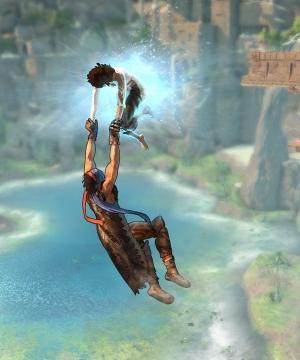
 Game developers have done death in creative ways. Prince of Persia works with the idea that you can control time and go back to the point when you were still living. In one game of the series, the main character is saved by the princess Elika, who swoops in and stops you from dying. But after one boss fight, Elika is frozen in time and the only way to revive her is to take a leap of faith, forcing her out of her frozen state to catch you. In that one moment, for the first time in the game, death becomes very real for the player.

Elika saves the prince. Again. Source: EMagill

Games like Prince of Persia threaten the player with death(as it should be) and add tension to a typically monotonous and unexplained game mechanism. In Halo 2, you play as the human super-solider Master Chief, arguably the only person who could save the known universe, and yet, you die and respawn over and over with the only consequence being mild annoyance. One could hypothesize that in games like this, when you die and respawn you're actually in an alternate dimension where you haven't died yet. Although, this is more of the philosophy. What about the mechanic?

In games, it's the simplest mechanic. You fall in a pit of spikes and, naturally, you die. If there's no fear of dying or failing the level, then there's less of a challenge and a game becomes boring. Games like Dark Souls emphasize death with high difficulty and challenge. Within the game, dying means losing all of your items, starting from the last save, and then going at it all over again(just thinking about it makes me want to burn the disk). So it really all depends on what game developers want to do--highlight or underplay death. Either option has its perks, but it still feels like most games treat death as an annoying tickle in the back of your throat, a hiccup on your interactive journey to the end, but then again, there are times when the narrative is more important than punishing the player.


Death defying time controls
 in Braid
Despite death's occasional annoyance, there are times when it becomes far more than a penalty. In fact, these modern games may be turning death into development. Braid, an award winning platform and puzzle game, actually requires that the player commit suicide in order to solve certain puzzles. It's a general concept; as you learn your way around any video game, sometimes you wonder "Can I make this jump?" The result for finding out is either advancing or starting over with a little more knowledge on what won't work.

In Super Meat Boy, an indie platform game, death becomes your tutorial. The main character, Meat Boy, can perform a great deal of stunts like double jumping, hopping up walls, and leaping over great distances, none of which you'd find out about with dying first. As Meat Boy, the only way your adventure continues is through death, as you instantly respawn and learn about your character and the world he lives in. The point of the game is to beat the levels as quickly as possible, so dying does become a hindrance. You have to become Meat Boy if you want to be the fastest.

In Super Meat Boy, you can see all your deaths on the same level at the same time. Source: SuperMeatBoy.com

Death is a challenge that game developers face. It asks a thousand questions and creates a million answers, but what we're seeing lately are the same solutions over and over again. Is that necessarily a bad thing? Maybe not, but neither is breaking the mold. The way a game deals with death has adverse effects on game play, narrative, and overall experience. We've seen some successful games turn death into a valuable part of the experience. Next time you hear the bell toll, don't wonder if it's for you--wonder when it'll toll next.


Special thanks to Jared Ashcraft for letting me pick apart his brain.


Tuesday, September 25, 2012

The God Mode: In Defense of Cheat Codes

Infinite lives. No gravity. Endless ammo. Playing as Spiderman in a dress.

These are all things you can have with cheat codes. Cheating in video games is almost as old as the industry itself. The first cheat codes were completely accidental, left in by game designers after testing and later revealed to the public. The idea caught on quick and Nintendo's popular subscription magazine, Nintendo Power, cashed in on the craze. They turned cheating into a market, branching out from cheat codes to hints and walk-throughs.

Players made cheating popular because it was fun! Now, new generation video games feature fewer and fewer cheat codes and more and more boring perks, like the ability to regenerate life whenever you want or spawn a random car. Gone are the days of big headed characters, fun character skins, and extreme strength.

Big titles like Call of Duty and Little Big Planet either have no cheat codes or repetitive, dull ones that we've seen time and time again. It seems cheat codes have been written right out of games, but they used to be such an integral part of gaming. We need them back.

In no way do I advocate cheating in multi-player games. I'm not talking about hackers either. You guys do your thing; I just want mine back. Well, as long as your thing doesn't bother anyone else(that's another post).

Gameception

Some might say cheat codes disturb the integrity of a game, that it distorts reality, but what happens when you put in a cheat code is actually a moment of suspension. The game is put on pause and at that time, you're playing with a game, not in a game. It becomes a plaything then. You're invincible. The story doesn't matter. The new story is yours.

The famous Konami Code
A game, like life, has rules. For example, there's gravity. Physics. Life or death. Cheat codes let you create your own rules as you go along. This type of game-play is completely different from the story or plot line. Sometimes, content isn't what we're looking for. 

A few weeks back, I was frustrated. Just those normal average stresses that come with being a student. I slipped Infamous into my PS3, started a new file, so as not to disturb my morally good file, and prepared for world domination. What I got instead was more frustration, frustration with the fact that my powers at the beginning of the game were so weak, that beating up people on the street just wasn't fun. So I quit and thought about writing this post.

What happened to sandboxes? To unlimited power? Stress release is a good reason for playing a game, no?
And you know what justifies buying a sandbox?

Consumer Codes

Face it. Video games are expensive. There are times we shell out 60 bucks for 9 hours of disappointment(Prototype...). Wouldn't you, the consumer, like some guarantee that even if a game is terrible, it'll have some use to you in the future? Cheat codes, my friends, cheat codes.

But having the ability to enjoy the game outside of its story has other pros as well. A lot of these new, story intensive games don't have the highest replay value. After one run through, you've pretty much done it all. That's when your buck stops with a bang. The game sits on a shelf simply for the purpose of player proof*. Definitely, cheat codes can make an old dog new again. 

Still not convinced? Well, I love gaming. I love it so much, I want everyone to play video games. But I'll admit, picking up a controller nowadays isn't as easy as it once was. When I started playing, Nintendo controllers had three basic buttons: the directional pad, "B," and "A."
Hemingwayesque, isn't it?

Gradually, over time, the controls became more complicated, but we grew along with them. Somehow, three buttons turned into 16 buttons. I didn't even notice it was happening! Hell, if I didn't play video games now, just looking at a PS3 controller would send me running back to Monopoly. Not to mention each console has its own type of controller.
It's alive!


Between constantly losing health and looking at the buttons, life as a new gamer isn't easy. Games can be difficult, even hard to understand. A walkthrough can easily help a new player move past a frustrating section in the game instead of giving up. Come on, game designers! Cheat codes are in your favor!

Easy Clean-Up

Besides what I've already mentioned, cheat codes provide an outlet for creativity.  Minecraft, a modifiable block world, originally began as an indie sandbox game. As it grew in popularity, cheat codes appeared that allowed players to fly and easily build structures. It became so popular that Minecraft officially incorporated it as "Creative Mode." 

Will Wright, creator of SimCity and Spore, has this to say about creativity:
"It’s really been about trying to construct games around the user, making them the center of the universe. How can you give players more creative leverage and let them show off that creativity to other people?"
It's not difficult to see the potential in cheat codes for self-expression or creativity. Entire games are devoted to it. Professors encourage it. Filmmakers live in it--Why shouldn't video games?

As games advance, cheat codes devolve. We have more complicated plots, controls, and graphics but our cheat codes are limited to changing the colors of our shirts from white to grey. But let's not forget that games are also easier today than they were when they first came out. Some games like Contra required codes just to beat them. So games today are definitely not as challenging as they were before, what with save files and unlimited lives, short chapters and incredibly quick ammo spawn times, but you can always add to the fun, to the replay value, and the creativity of a game.

And...

Yo momma so fat, she has cheat codes for Wii Fit!

Ooh, what?! Ya'll been told.


*Player Proof: Games that sit on your shelf only to make you feel more cultured or experienced. 

 
Bloggerized by Lasantha