Showing posts with label video games. Show all posts

Monday, January 14, 2013

The Art of Video Games: South Florida's First Video Game Exhibition

This past weekend I had the pleasure of visiting the Boca Raton Museum of Art, mostly to see its newest exhibition and the Smithsonian's travelling exhibit, The Art of Video Games. I was excited, as giddy as a school girl. Just could not wait!

Unfortunately, we got there an hour early, but at 12PM sharp, we were at the doors, advancing towards the first video game exhibition to ever visit South Florida. Needless to say--excited. As soon as we walked in, we were greeted by a sign that said "No Photography." Ouch. My ego was hurt quite a good bit, being that I had already perused the website about this particular topic and found nothing that would deny me my hobby. But alas! It seems photography was not in the cards for me today...

JK. I have pictures from the museum anyway, taken on a camera phone, but it wasn't me. I swear.

Near the entrance of the exhibit, we found these awesome people
wearing awesomely appropriate shirts.
At the very entrance of the exhibit, a projection, playing a short video that rotated the most popular and well known video games: Pac-Man, Super Mario Bros, Donkey Kong, Star Fox, etc. Further on, the walls were lined with kiosks that each contained a game console, starting with the Atari 2600, home of Combat and the personal version of Pac-Man, and ending with the Playstation 3. These kiosks concentrated on four main genres: target, adventure, action, and tactics, while also concentrated on the 8-Bit, Bit Wars, Transition, and Next Generation eras. Smack dab in the middle of the exhibit were inviting cubicles that allowed guests to stand and play some of the games. The cubicles had tiny cameras with feeds that were connected to three televisions hooked up side-by-side in the middle of the room. These televisions showed the faces of guests, young and old, disgruntled or amazed by the games in front of them.

People playing games.

The kiosks were the main attraction of the exhibit. Featured games included The Legend of Zelda, Pitfall, Spy Vs. Spy, Gunstar Heroes, Star Fox, Sonic, Shenmue, and Heavy Rain to name a few. They were interactive and informative, each with buttons reflecting one of the four genres. Listeners enjoyed a short lesson on each of the games presented. It was educational, but certainly not boring.

"Original" Sonic in Character Development

Besides the kiosks and cubicles, there were also a few sketches here and there that seemed to be enlarged copies of original artist renderings:


Now, there wasn't really much art, so to say. The exhibit relied heavily on its interactive electronic kiosks as well as its informative looping 5 minute videos and the whole space was small, and not necessarily well designed to match with the entrance to the next exhibit. Even though I had a good time, I was still moderately disappointed. The title of the exhibit displays, perhaps, some kind of art, of which there was relatively few of. It felt more like a history lesson, and for me and my friends, a trip down memory lane. However, the set up and pieces of the exhibit are perfect for a crowd that knows very little about video games. In that aspect, it works very well.

This one was definitely original art.
A troll from Wow!
Later on, at a restaurant, my friends and I were discussing why we felt disappointed, and in hindsight, once we dug each other out of our nostalgic holes, the answer was simple--so much about video games was just not there.At the start of the exhibit, we saw the home edition of Pac-Man, which falls behind the pixelated beauty of its arcade version.And what many video game authorities consider, even in part, as the beginning of video games, Pong, was nowhere to be seen. Now, had this been actually about video game art, this would make sense. Pong might be zen, but it's not really graphic heavy...but this exhibit depended heavily on teaching the audience about the eras of gaming and the history. So where was Pong?

Even more disconcerting was the complete disregard for handheld devices like the PSP, with its sharp graphics, and the GameBoy. The GameBoy! Father of all handheld devices, with games that encouraged immense art collections and fan art, such as Pokemon. And in the Next Generation section, no mention of mobile gaming, which to me, is as much a part of next generation gaming as an Xbox 360. It has reached out to and made gaming accessible for countless people, and yet, no mention.

And no Tetris. Nope. Let me not even go there.

Perhaps it was a lack of space. Perhaps it was a ploy to sell coffee table books. Perhaps just a shameless commercial plug, but most likely a misnomer of an exhibit. Would I recommend this exhibit to an art student? No. A video game fan? For the discounted student price, yes. For the young child or aspiring gamer? Absolutely. The exhibit in itself is a learning experience, I hope, for both viewer and curator.  And if you're looking for a fast ticket to Memory Lane, you'll find it here, but for a price.

Monday, November 5, 2012

Political Games: A Gift and a Curse

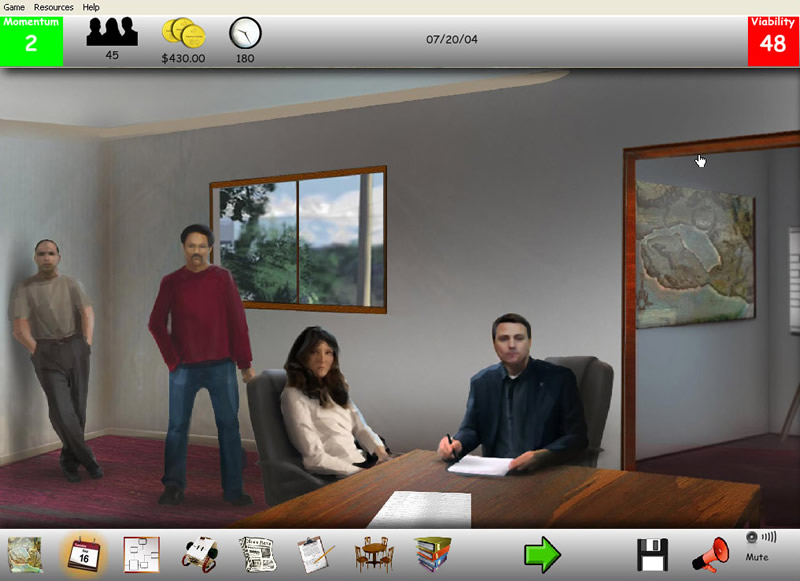
The gaming world has often tried to keep its wires from getting tangled up in politics, but since 2004, political video games have begun to surface. According the Entertainment Software Association, the amount of political games has tripled since then. Some liberal, other conservative, political video games aim to entertain and educate at the same time.

Strategery 2012 is one such game, where you can play as Romney's election team during the primaries and then as Obama's team during the general election. It follows the format of Nintendo's popular military turn-based strategy games, the Advance Wars series. As the player, you go up against several opponents as volunteers, press secretaries, and fundraisers, each with a minimum "credibility" score. It's a funny, quirky game that gets across the amount of thought, dedication, and work that can go into an election.

While many are slightly biased and contain the opinions of their developers, as well as cracking jokes about candidates, some of these games try to teach political fundamentals. Gerrymandering is a huge issue in the United States, mostly because no one knows about it. But the good folks at the USC Game Innovation lab created The Redistricting Game, focusing on teaching players the basics of redistricting. Even though it didn't catch the media's eye, it's one of the best examples of gaming that promotes civic action.


Yes, it is.

Besides actually making these types of games, some companies are promoting the current election. Even though most politicians aren't much into the world of button mashing, Obama included, Microsoft got in the game. During the Presidential Debates, Xbox promoted "Election 2012" on Xbox Live, offering, for those who watch three of the four debates, free Halo armor...in gold! During the debates themselves, Microsoft also polled viewers, and, no surprise, lots of democratic and male voters.

Gamers also find themselves rooted in politics, especially those who are already involved in it. The U.S. Libyan diplomat, Sean Smith, who recently died during an attack on the American Embassy in Libya, was a huge member of the Eve Online community, a sci-fi based MMORPG. In fact, after his death, tributes were made in his name, "Vile Rat," as players, friend and enemy alike, renamed their space stations in his honor.  In game, he was as hard a diplomat as he was in real life. One of his friends online, Alex Gianturco, who he also met in real life, said "If you play this stupid game, you may not realize it, but you play in a galaxy created in large part by Vile Rat's talent as a diplomat. No one focused as relentlessly on using diplomacy as a strategic tool as VR."

Lachowicz's WoW
Character, Santiaga
But not all politically oriented people are praised for their hard work in the gaming community. One World of Warcraft player was "deemed unfit for office" based on her involvement with the popular MMORPG. Colleen Lachowicz, democrat and level 85 Orc rogue, was the subject of a smear campaign by the Republican Party of Maine, who claim she's unfit for office due to her "double life" and violent comments online. Lachowicz hit back:

I think it's weird that I'm being targeted for playing online games. Apparently I'm in good company since there are 183 million other Americans who also enjoy online games. What's next? Will I be ostracized for playing Angry Birds or Words with Friends? If so, guilty as charged!
What's really weird is that the Republicans are going after my hobbies instead of talking about their record while they've been running Augusta for the last two years. Instead of talking about what they're doing for Maine people, they're making fun of me for playing video games. Did you know that more people over the age of 50 play video games than under the age of 18? As a gamer, I'm in good company with folks like Jodie Foster, Vin Diesel, Mike Myers, and Robin Williams. Maybe it's the Republican Party that is out of touch.

Ouch.

Politics and video games may not always get along, but the truth sits in an industry with unlimited potential for educating and informing the public. Last year, the gaming market was worth $56 billion dollars, "more than twice of the recorded-music industry, nearly a quarter more than the magazine business and about three-fifths the size of the film industry." And it's only expected to rise from there. Australia and the UK have seen the potential and already offered tax incentives for video games. It shouldn't be long before the U.S. is on board. Video games are the future of civic engagement, and though some may disagree with much of the medium, it's long-reaching, powerful, and most importantly, fun. 

Friday, October 12, 2012

Indie Game: The Movie--Review

From what began as a Kickstarter project, Canadian producers Lisanne Pajot and James Swirsky followed the lives of three indie game developers, highlighting their struggle, successes, and deepest desires. As the first documentary on indie games, a lot was expected from this film, but I'm here to tell you that it delivers, even if not how many hoped it would.

The film follows the game designers behind the extremely popular indie games Super Meat Boy, Fez, and Braid. Jonathan Blow, creator of Braid, is probably the lesser focus of the three, but is instead intended as an example of success in the indie world, coming in and out of the film in a few short bursts to talk about his journey and his post-success. But at the very core of this movie sits the personal and emotional story of Phil Fish(Fez) and the super duo Edmund McMillen and Tommy Refenes(Super Meat Boy).

This movie was amazing. Pajot and Swirsky are incredibly involved and passionate about these games and their developers, and it shows. The two make certain that the focal point of the movie are the designers through tactics like close-ups, interviews, and, oftentimes, very personal questions. It aims to show and start a dialogue about indie designers and it accomplished this by giving the backstage tour of four real people.


The main character of Fez gets his
3-D powers from wearing the
Arabian hat of the same name.
I've seen many a review that complain about the dramatic moments in the film. There's a lot of mention that these "dramatic" scenes involve drawing out events that would normally be humdrum in real life, like for example, when Fish's game Fez encounters buggy problems during its debut at PAX. Sure, many of the scenes as well as the same themes show up often--McMillen and Refenes' time crunch and Fish's depression--but it does reveal the truth behind these three gamer designer's life. That truth is repetition. Like any passion or goal in life, repetition is going to come up. These are people who sit at desks for unwarranted amounts of time because they're life dream demands it. Yeah, it's repetitive...

...but it only furthers that real sense or feeling behind these men and their lifelong goals. Indie developers are real people with real problems and real reactions, and the way it's framed by Pajot and Swirsky offers an accessible, human approach to a field that is typically considered cold, calculating, and computer generated. 

This is the true side of indie games, featuring the struggle but also that drive that makes these games so fresh, appealing, and inherently human. McMillen talks about his childhood, about his fear of loneliness, of becoming so engrained in a project that he cuts himself from the world completely. These thoughts and emotions cultivated themselves in McMillen's game, Aether, where a boy and his monster glide through the galaxy in search of a friend. There's such a real, genuine thing here that commercial games mainly lack--a true human side to the worlds we escape to.

Edmund McMillen probably comtemplating monsters, sales day, and hairless cats.
Source: Rock Paper Shotgun

Of course, like so many other fantastic films, this one too had its flaws. The first one made plainly visible is the film's lack of history on the indie industry. Just who is the audience here? Some more experienced gamers  might have this history down but the newcomers or the people who have never laid a finger on a directional pad might have no clue about the enormous history of indie games. There are a few places within the movie that I found myself asking "Would someone outside the game industry have any idea what that is?" And yet, this lack of information is not just a negative, but a positive in the sense that it may propel the viewer into researching more.

While the lives of these developers were surely interesting, I also found it generated a lot of questions about the actual games themselves. Braid, for example, has some very original and interesting time mechanics that are never mentioned. We hear Blow talk about his disappointment when he realizes that people are liking his game but missing the point he intended and yet, we never get to see the game and make our own opinions on why that may be. Similarly, Fez is a 3-D and 2-D world, but for people outside of the gaming diaspora  it might not be easy to see why that's so mind-boggingly awesome or refreshing just from the film alone. By leaving out the intelligence and inner-workings of the game, Pajot and Swirsky also paint the indie industry as creators of platforming games only, which is a huge mistake.

Even with these flaws, it's easy to argue that Pajot an Swirsky knew what they were doing. Easily, they entice the audience, gamer or not, to want to watch these lives pan out. The emotion is there, right on screen. It almost feels like you're right there with them, experiencing these failures and successes altogether. By the end of the film, you're rooting for these people. This is an incredible documentary that tells it like it is and manages to open the door for the next wave of indie films to answer the questions it stirs up inside us.

You can watch Indie Game: The Movie on Netflix currently, and buy your own hard copy at a steal from indiegamethemovie.com.


Also, stay tuned for indie games of 2012!

Sunday, October 7, 2012

For Whom the Game Tolls


Therefore, send not to know
For whom the bell tolls,
It tolls not for thee.

Okay, so I may have done a little editing there, but it's true--modern game characters don't really ever die. Think back to the days of Mario, when losing a life could be the difference between losing an hour of your own life and having the time of your life. No worries though. You can always start over. The concept of lives and Game Over screens are a vestigial aspect of arcade games, long before home consoles were created. People became accustomed to the idea and so, it stuck. But as the industry progressed, so too did the role of death. Instead of players suspending their beliefs to participate in a game, death as a mechanic and death as a philosophy intertwine in the games of today.

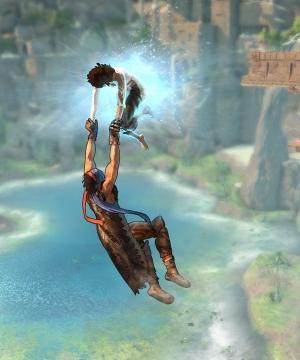
 Game developers have done death in creative ways. Prince of Persia works with the idea that you can control time and go back to the point when you were still living. In one game of the series, the main character is saved by the princess Elika, who swoops in and stops you from dying. But after one boss fight, Elika is frozen in time and the only way to revive her is to take a leap of faith, forcing her out of her frozen state to catch you. In that one moment, for the first time in the game, death becomes very real for the player.

Elika saves the prince. Again. Source: EMagill

Games like Prince of Persia threaten the player with death(as it should be) and add tension to a typically monotonous and unexplained game mechanism. In Halo 2, you play as the human super-solider Master Chief, arguably the only person who could save the known universe, and yet, you die and respawn over and over with the only consequence being mild annoyance. One could hypothesize that in games like this, when you die and respawn you're actually in an alternate dimension where you haven't died yet. Although, this is more of the philosophy. What about the mechanic?

In games, it's the simplest mechanic. You fall in a pit of spikes and, naturally, you die. If there's no fear of dying or failing the level, then there's less of a challenge and a game becomes boring. Games like Dark Souls emphasize death with high difficulty and challenge. Within the game, dying means losing all of your items, starting from the last save, and then going at it all over again(just thinking about it makes me want to burn the disk). So it really all depends on what game developers want to do--highlight or underplay death. Either option has its perks, but it still feels like most games treat death as an annoying tickle in the back of your throat, a hiccup on your interactive journey to the end, but then again, there are times when the narrative is more important than punishing the player.


Death defying time controls
 in Braid
Despite death's occasional annoyance, there are times when it becomes far more than a penalty. In fact, these modern games may be turning death into development. Braid, an award winning platform and puzzle game, actually requires that the player commit suicide in order to solve certain puzzles. It's a general concept; as you learn your way around any video game, sometimes you wonder "Can I make this jump?" The result for finding out is either advancing or starting over with a little more knowledge on what won't work.

In Super Meat Boy, an indie platform game, death becomes your tutorial. The main character, Meat Boy, can perform a great deal of stunts like double jumping, hopping up walls, and leaping over great distances, none of which you'd find out about with dying first. As Meat Boy, the only way your adventure continues is through death, as you instantly respawn and learn about your character and the world he lives in. The point of the game is to beat the levels as quickly as possible, so dying does become a hindrance. You have to become Meat Boy if you want to be the fastest.

In Super Meat Boy, you can see all your deaths on the same level at the same time. Source: SuperMeatBoy.com

Death is a challenge that game developers face. It asks a thousand questions and creates a million answers, but what we're seeing lately are the same solutions over and over again. Is that necessarily a bad thing? Maybe not, but neither is breaking the mold. The way a game deals with death has adverse effects on game play, narrative, and overall experience. We've seen some successful games turn death into a valuable part of the experience. Next time you hear the bell toll, don't wonder if it's for you--wonder when it'll toll next.


Special thanks to Jared Ashcraft for letting me pick apart his brain.


Tuesday, September 25, 2012

The God Mode: In Defense of Cheat Codes

Infinite lives. No gravity. Endless ammo. Playing as Spiderman in a dress.

These are all things you can have with cheat codes. Cheating in video games is almost as old as the industry itself. The first cheat codes were completely accidental, left in by game designers after testing and later revealed to the public. The idea caught on quick and Nintendo's popular subscription magazine, Nintendo Power, cashed in on the craze. They turned cheating into a market, branching out from cheat codes to hints and walk-throughs.

Players made cheating popular because it was fun! Now, new generation video games feature fewer and fewer cheat codes and more and more boring perks, like the ability to regenerate life whenever you want or spawn a random car. Gone are the days of big headed characters, fun character skins, and extreme strength.

Big titles like Call of Duty and Little Big Planet either have no cheat codes or repetitive, dull ones that we've seen time and time again. It seems cheat codes have been written right out of games, but they used to be such an integral part of gaming. We need them back.

In no way do I advocate cheating in multi-player games. I'm not talking about hackers either. You guys do your thing; I just want mine back. Well, as long as your thing doesn't bother anyone else(that's another post).

Gameception

Some might say cheat codes disturb the integrity of a game, that it distorts reality, but what happens when you put in a cheat code is actually a moment of suspension. The game is put on pause and at that time, you're playing with a game, not in a game. It becomes a plaything then. You're invincible. The story doesn't matter. The new story is yours.

The famous Konami Code
A game, like life, has rules. For example, there's gravity. Physics. Life or death. Cheat codes let you create your own rules as you go along. This type of game-play is completely different from the story or plot line. Sometimes, content isn't what we're looking for. 

A few weeks back, I was frustrated. Just those normal average stresses that come with being a student. I slipped Infamous into my PS3, started a new file, so as not to disturb my morally good file, and prepared for world domination. What I got instead was more frustration, frustration with the fact that my powers at the beginning of the game were so weak, that beating up people on the street just wasn't fun. So I quit and thought about writing this post.

What happened to sandboxes? To unlimited power? Stress release is a good reason for playing a game, no?
And you know what justifies buying a sandbox?

Consumer Codes

Face it. Video games are expensive. There are times we shell out 60 bucks for 9 hours of disappointment(Prototype...). Wouldn't you, the consumer, like some guarantee that even if a game is terrible, it'll have some use to you in the future? Cheat codes, my friends, cheat codes.

But having the ability to enjoy the game outside of its story has other pros as well. A lot of these new, story intensive games don't have the highest replay value. After one run through, you've pretty much done it all. That's when your buck stops with a bang. The game sits on a shelf simply for the purpose of player proof*. Definitely, cheat codes can make an old dog new again. 

Still not convinced? Well, I love gaming. I love it so much, I want everyone to play video games. But I'll admit, picking up a controller nowadays isn't as easy as it once was. When I started playing, Nintendo controllers had three basic buttons: the directional pad, "B," and "A."
Hemingwayesque, isn't it?

Gradually, over time, the controls became more complicated, but we grew along with them. Somehow, three buttons turned into 16 buttons. I didn't even notice it was happening! Hell, if I didn't play video games now, just looking at a PS3 controller would send me running back to Monopoly. Not to mention each console has its own type of controller.
It's alive!


Between constantly losing health and looking at the buttons, life as a new gamer isn't easy. Games can be difficult, even hard to understand. A walkthrough can easily help a new player move past a frustrating section in the game instead of giving up. Come on, game designers! Cheat codes are in your favor!

Easy Clean-Up

Besides what I've already mentioned, cheat codes provide an outlet for creativity.  Minecraft, a modifiable block world, originally began as an indie sandbox game. As it grew in popularity, cheat codes appeared that allowed players to fly and easily build structures. It became so popular that Minecraft officially incorporated it as "Creative Mode." 

Will Wright, creator of SimCity and Spore, has this to say about creativity:
"It’s really been about trying to construct games around the user, making them the center of the universe. How can you give players more creative leverage and let them show off that creativity to other people?"
It's not difficult to see the potential in cheat codes for self-expression or creativity. Entire games are devoted to it. Professors encourage it. Filmmakers live in it--Why shouldn't video games?

As games advance, cheat codes devolve. We have more complicated plots, controls, and graphics but our cheat codes are limited to changing the colors of our shirts from white to grey. But let's not forget that games are also easier today than they were when they first came out. Some games like Contra required codes just to beat them. So games today are definitely not as challenging as they were before, what with save files and unlimited lives, short chapters and incredibly quick ammo spawn times, but you can always add to the fun, to the replay value, and the creativity of a game.

And...

Yo momma so fat, she has cheat codes for Wii Fit!

Ooh, what?! Ya'll been told.


*Player Proof: Games that sit on your shelf only to make you feel more cultured or experienced. 

Tuesday, September 18, 2012

Can Saving the World be Fun?


Friday, September 21st is a day that means nothing to a good portion of the world. To many, it’s the end of the work week and the start of the weekend. But most don’t know that Jeremy Gilley put forth immense effort to have September 21st recognized by the United Nations as Peace Day.

And succeeded.

September 21st is officially Peace Day! This isn’t news, though. Peace Day has been around for over a decade, but the news hasn’t reached our ears yet. How can there be peace if no one knows it exists? Part of the problem is spreading the word, but the other half of the problem is that awareness can only go so far, and that distance is about 30 feet in any direction.

We hear about social issues all the time. Organizations try to catch our eye with emotionally appealing commercials and guilt trips. Sarah McLaughlin’s depressing song does wonders for reflexes as we trip over ourselves to change the channel. They may be able to put some tears in our eyes, but as soon as Friends comes back on, the tears evaporate. God forbid you should be walking by the university library on the day someone’s advocating global warming. In which case, you get something like this:

Can you spot the students? Eight of them are in this picture.

The problem isn’t us (sort of)—it’s the medium. Television doesn’t leave a lasting impression. Advocators are annoying so we avoid them. And donations, while helpful, are just a way to clear out the change. “Well,” you say. “You sure are talking high n’ mighty there. If you know so much, how do we fix it then?”

Simple—with video games.

Now, I’m not the first to say that, and I probably won’t be the last, but using video games as a medium to not only raise awareness, but also involvement, is an excellent option. Beneath the bloodshed and the grenade explosions, the nymphs and the dragons, there’s also a desire for peace. We want it in video games. We want to restore the world to a proper state, where all its inhabitants can be happy. So why not merge one of the most expansive mediums with some of the more engrossing social issues?

The United Nations’ World Food Programme(WFP) released its first PC game—Food Force—in 2005, for the fight against hunger. The game itself registered over 10 million users, prompting the WFP to cozy up with Konami Digital. This led to the 2011 release of Food Force…for social media. Playable on Facebook, the game takes advantage of this social media perk by leading the player, and their chosen Facebook friends, though six levels where they face obstacles while sending out humanitarian aid, growing crops, and raising farm animals in order to create a “real world impact.”

Not unlike Food Force, Zynga, a social media game developer, helped raise money for Water.org by offering a blue water bison for purchase, raising $300,000 for the organization!

Yeah, all of these are organizations dedicated to helping social causes, but what if I told you it's not just lobbyists and hippies*?  MTv has put their best foot forward in an attempt to raise awareness about the problems in Darfur. In 2006, MTv released Darfur is Dying, a video game aimed at illustrating the lives of Darfurian people in refugee camps. You play as 1 of 10 characters, each of which has to increase the survival of the camp by doing things like foraging for water. The game does a good job of interweaving action with purpose, having dire consequences for failing, such as losing a character to death or possibly even rape. As you play, the back story of the Darfur conflict unwinds.


Games like Darfur is Dying revolve around survival, but there are also games that promote peace. After the September 11th attacks, NewsGaming.com unveiled its first game, September 12th. In the game, the more violence you use to stop terrorism, the more terrorists are made. The goal of the game is to decrease violence and also to show how "current US tactics on the war on terror affect the civilian population and generate more terrorism." After the Madrid bombing, NewsGaming.com released Madrid, which paid homage to the victims.

People Power: The Game of Civil Resistance
Steve York also created A Force More Powerful, based on the 1999 documentary, which is credited as being the "first interactive teaching tool in the field of nonviolent conflict." Players used several nonviolent strategies and tactics like boycotting and protesting to successfully solve conflicts around the world. The game has since been discontinued, paving the way for The International Center for Nonviolent Conflict to create a more updated game based on the same principles, People Power: The Game of Civil Resistance. This one is far more personal, as you embody a leader of a popular movement.


Funding is an issue. It's always an issue. For an advocacy video game to be interesting, it needs to look good and feel good. Making a commercial video game can cost more than most films. In fact, A Force More Powerful required $3 million dollars, while the game sold for about $20. Darfur is Dying was created on a
$50,000 grant and despite its much smaller budget, it gets the point across. Funding will affect the reach a game may have, but it doesn't detract from the deeper sentiment of the game.

Video games reflect a billion dollar industry. They're growing with this generation and are just begging to be put to work, even more so then what's already out there. Just in commercial games alone, you find the need for peace and the binary of morality. Games like Deus Ex and Infamous don't reward you for being good. Actually, being good is difficult, and in some cases, way harder than being good (i.e. sneaking around to avoid casualties).

And yes, there are violent games. Just like there are violent movies and violent books and violent music and round and round we go. But those games that can be classified as more violent than others--shooters in specific--are not the top selling genre(granted they're the second, but only one genre of many).

The complexity of our cultures and our world is what makes video games so accessible, interesting, and personal. Such intimacy created between game and gamer is a strong one. It puts you right there, in the area of conflict. Sometimes you're in trouble. Sometimes only you can save the world. In this case, only we can save the world. This type of interactive intimacy brings us closer to the issues people face every day, to the community, and to ourselves. It's time to get serious about gaming and connect with the millions that are already playing them.

Can saving the world be fun? Yeah, why not?


*Don't hit me.


Friday, September 14, 2012

The Baseline is: Video Game Writers Suck


On September 12, The Atlantic interviewed Junot Diaz on his new book, but what came out was probably the most sought after explanation for tawdry, scantily-clad video game females this world over. Plainly said:

Guys, you suck.

In Mr.Diaz’s own delicate, refined prose, he states:

“The one thing about being a dude and writing from a female perspective is that the baseline is, you suck. The baseline is it takes so long for you to work those atrophied muscles—for you to get on parity with what women's representations of men are. For me, I always want to do better. I wish I had another 10 years to work those muscles so that I can write better women characters. I wring my hands because I know that as a dude, my privilege, my long-term deficiencies work against me in writing women, no matter how hard I try and how talented I am.”

Some part of me, honestly, gave men the benefit of the doubt. I simply assumed that they were doing it for marketing purposes or just illustrating the female form as it has been for centuries—as a sexualized object. But no, it hadn’t occurred to me that maybe, just maybe, men can’t write.

Can’t write women, of course.

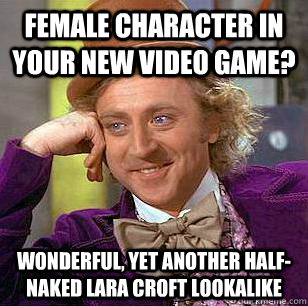
When you take a look at the few female game designers that are out there, it’s easy to understand why so many Croftesque* characters make it to the shelves. In the UK alone, women make up only 12% of the industry. But the few women who work hard for their wages have made memorable games.

Amy Hennig, head writer and creative director for the immensely successful Uncharted series, helped create believable women, rooted in reality. The series' three main female characters—Elena, Chloe, and Marlowe—feature full clothes, strong wills, independence, and the average bust. None of that impossible bust to waist ratio. These are women you could picture seeing, maybe having a meal at the mall or walking their dogs.
Take a look at those massively average breasts (Source: Naughty Dog)

Hennig isn’t the only woman known for creating down to earth women. You’d be surprised to know that quite a few leading games have women behind the scenes, including Gears of War 3 and Deus Ex.
Now, this isn’t a new topic at all. This is an industry that has been dominated by misogynistic thinking since it's beginning, leading to the creation of many fantastic characters like Heavenly Sword's Nariko or Resident Evil's Jill Valentine, but also some that lacked, say, a women’s touch. This includes female characters that are extremely masculine, have no thought process, can’t dress (more so my own nitpick), and/or  are solely for rescuing.

Quite a good deal of games feature a male protagonist, or rather, a mandatory male protagonist. Many titles, like Infamous or Grand Theft Auto,  focus on solely one character's journey, who tends to be male.As such, it's easy for other characters, namely female ones, to fall short of grandeur and become a prop. Eventually, however, this wasn't the only option. One of the few genres of video games that first began adding the gender choice were MMORPGs like World of Warcraft. Now we have PC and console games like Dragon Age and Fallout, which allow the player to customize their characters, gonads included.

Of course, the notion of what is a "real woman" will always come into play here, and by allowing customization, the "real woman" is up to the player's own definition. And like most things, this quick fix can also perpetuate these same misogynistic norms, but it's a step in the right direction (and maybe another post).

It’s clear that we could use more choice in the hands of the player, since, Mr.Diaz so eloquently put it, male writers suck at creating the real woman. More customization means more happiness for all of us. The boys get their bimbos and the girls get their heroes. In this way, women can become more immersed in the game world, as they play what could be a representation of themselves, instead of living out someone else's story. But writers also need to step up to the plate and reinvent the idea of woman as strong, yet sentimental, brave, but not afraid to admit fear, and real. Just real.


*Croftesque: Qualities of Lara Croft, including large breasts, tiny waist, and a huge...you get the point.

Monday, September 10, 2012

You Should Read This #1

“What we’re seeing in games is art at a world-class stage design that is almost unmatched anywhere else. It has been very exciting to me to see so many ideas that integrate social good and efforts to make the world a better place into games.”
 -Al gore


Source:

Friday, September 7, 2012

The Average Gamer


“The Princess is in another castle!”

If you recognize that line (don’t you dare google it), then welcome to the exclusive, super-secret world of video gamers! Membership is selective and offers a lifetime of good times.

A lifetime!

That’s a lot of time. But wait! Why dedicate your life to videogames? Well, everyone else is doing it. Over 50% of American households enjoy some kind of console, ranging from the family friendly Wii to the hard brick of Xbox. You might be thinking to yourself “Wow, that’s over half of the population!”

Yeah, it is, you smart cookie.*

Credit: Entertainment Software Association
Video games are popular, not just in the U.S, but around the world.  This is due partly to their success as entertainment, but like television, music, and books, video games, too, have a higher calling. They reflect the life and culture around us and make some serious social commentaries about the world we live in.

Games take actuality’s afflictions and shove them in your face, force you to play through them, to realize and grow with them. Video games are about us, about humans, the human condition, and the perils we may face. They place you in the center of the action—your own backyard.

While video games might have been for 12 year olds once upon a time, they have been elevated in terms of respect and opinion. I believe this day and age is a huge turning point for the role video games play in our society. They are becoming less and less a young boy’s toy or an unemployed 40 year old man’s only escape from his mother's basement and more of an interaction between us and our inner thoughts.

Video games offer a type of personal intimacy that no film or music can. Playing a video game, more often than not, requires your full attention and interaction. There’s not much else you can do while that control is in your hand. The whole world is at your fingertips, and you must save it.

It is because of this intimacy that young and old alike are plunged into a constant fight against the plights of humanity. We engage in what is not an alternate reality, but another lens to view our surroundings with instead. There are many reasons why we play video games, stemming from the urge for entertainment to the desire for superhuman abilities, but behind the cartoon characters and the imaginative fiction lies a truth.

And that is what we hope to discover.

Join me as we examine video games from some new angles…and some old ones too.


*Cookies aren't smart, but I'm bad at math.

 
Bloggerized by Lasantha